36 free quilt blocks, one a week with a guide to Jane Austen's England and posts about the people in her life.

Sunday, November 9, 2014

Block 32: Ladies’ Wreath for Elizabeth Bridges Knight


Block 32: Ladies’ Wreath for Elizabeth Bridges Knight, 
Jane’s Sister-in-Law by Bettina Havig

Elizabeth Bridges Knight (1773-1808)

Jane Austen’s brother Edward Austen Knight lived a fairy-tale life. His rise in society after his adoption by rich relatives is reflected in his advantageous marriage in 1791. He married the Hon. Elizabeth Bridges, daughter of a baronet. Evidence of the warm relationship between Edward and Elizabeth is their eleven children.

A 19th-century view of woman’s passage through life 

Whether daughter of a baronet, a tinker or a tailor, women were confined in a biological and societal progression…


…with far too many lives cut off by childbirth.

Ladies' Wreath by Dustin Cecil

Elizabeth died at the age of 35 following the birth of her eleventh child in 17 years. The Austen family lost several sisters-in-law to motherhood. Frank’s first wife also died after the eleventh baby, Charles’s wife after the fourth.

With little access to information about birth control, sex meant that wives were continually pregnant. The reliable way to avoid pregnancy was abstinence, as Jane phrased it: “the simple regimen of separate rooms."


Mourning photograph, about 1860

In Jane Austen’s England a woman had an 80% chance of surviving childbirth. For each individual birth the overall maternal mortality rate (number of women dying in childbirth) is estimated to have been 7.5 per 1,000 births. Today in the U.K. the maternal mortality rate has been reduced by about 99% to 8.2 deaths in 100,000 live births.

Ladies' Wreath by Becky Brown


Ladies’ Wreath can represent the mourning wreath on a young family’s door. The block was given the name in the early 20th century by the Ladies’ Art Company.


BlockBase #1131

Cutting a 12" Finished Block


A - Cut 12 squares 3-7/8".
Cut each in half diagonally to make 2 triangles. You need 24 triangles.

B - Cut 4 squares 3-1/2".


Ladies' Wreath by Becky Brown


Read more about the causes of maternal mortality by clicking here:
http://www.ncbi.nlm.nih.gov/pmc/articles/PMC1633559/

“British maternal mortality in the 19th and early 20th centuries,” by Geoffrey Chamberlain, Journal of the British Medical Society
And see the statistics on the rate today at The Guardian:
http://www.theguardian.com/news/datablog/2010/apr/12/maternal-mortality-rates-millennium-development-goals

Ladies' Wreath by Georgann Eglinski

I also used this block in my 2012 block-of-the-month on women's rights. See the post at Grandmother's Choice by clicking here:
http://grandmotherschoice.blogspot.com/2013/02/26-ladies-wreath-mourning-for-mother.html

Sunday, November 2, 2014

Block 31: Lady of the Lake for Sir Walter Scott


Block 31: Lady of the Lake for Sir Walter Scott by
Bettina Havig


Walter Scott (1771 -1832)


Walter Scott was a literary lion, as celebrities were known in Jane Austen’s England. Scott was first lionized for his poetry chronicling a romantic Scottish past. Jane’s brother James read Scott’s poem Marmion aloud to the family in the evenings. Wrote Jane: “Ought I to be very much pleased with Marmion?-as yet I am not.”


The Lady of the Lake illustrated by 
Charles E. Brock, 1904


Etching by Cruickshank

Scott's 1810 poem, The Lady of the Lake, sold 25,000 copies making him rich.The following year Sense & Sensibility, Jane’s first published novel, appeared. The Austens (probably Henry and Eliza) put up money for printing and publicity. With sales of 750 copies, Jane earned £140 over that investment.


An American silk picture embroidered about
1810. Scott's historical fiction particularly touched Southerners
and other Americans with Scots-Irish roots.


Scott then turned to prose fiction with Waverly and Jane commented to niece Anna, “Walter Scott has no business to write novels, especially good ones. -- It is not fair. He has Fame and Profit enough as a Poet, and should not be taking the bread out of other people's mouths.-- I do not like him, and do not mean to like Waverley if I can help it -- but fear I must.”


The Quarterly Review was published by John Murray, 
the prestigious house that published Scott, Byron and Jane Austen’s Emma.

Five years later Scott criticized Jane in a public book review. Discussing Emma for The Quarterly Review, he was positive but not overly enthusiastic.

“The author is already known to the public by the two novels [which] belong to a class of fictions which has arisen almost in our own times, and which draws the characters and incidents introduced more immediately from the current of ordinary life than was permitted by the former rules of the novel.”
Scott distinguished between the former rules, which presented “splendid scenes of an imaginary world” and Jane Austen’s new genre, giving “a correct and striking representation of that which is daily taking place….

"We, therefore, bestow no mean compliment upon the author of Emma, when we say that, keeping close to common incidents, and to such characters as occupy the ordinary walks of life, she has produced sketches of such spirit and originality, that we never miss the excitation which depends upon a narrative of uncommon events.”

Lady of the Lake by Becky Brown

Was this faint praise?  A decade later he was more enthusiastic to his journal:

“Read again, and for the third time at least, Miss Austen’s very finely written novel of ‘Pride and Prejudice.’ That young lady has a talent for describing the involvements and feelings and characters of ordinary life which is to me the most wonderful I ever met with. The big bow-wow strain I can do myself like any now going; but the exquisite touch, which renders ordinary commonplace things and characters interesting, from the truth of the description and the sentiment, is denied to me.”
It seems he was as envious of Jane’s skills as she was of his financial success.


Captain Benwick by Charles Brock from Persuasion, 
in which Anne Elliot and the Captain discuss romantic poets 
Scott and Byron.


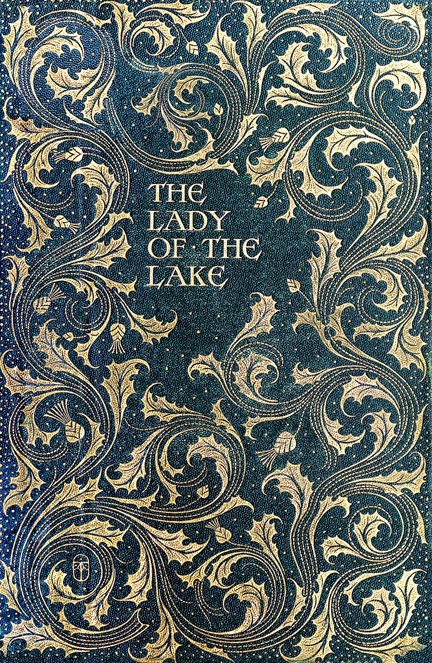
Lady of the Lake became a classic, with editions in arts and crafts style popular at the turn of the 20th century. This version, illustrated by Howard Chandler Christy, celebrated the epic verse's centennial in 1910.

Lady of the Lake by Becky Brown


BlockBase #2183 and K020

Lady of the Lake, named for Scott’s “big bow-wow strain” of a poem, is perfect to recall Jane Austen’s fan and fellow novelist. The name was given a similar pattern by the Ladies’ Art Company about 1900,  inspired, perhaps, by the poem's upcoming centennial. The pattern is a modified version of BlockBase #2183 (similar to #K020).

Cutting a 12” Block

A - Cut 20 squares 2-7/8” (5 each of 4 shades). Cut each in half with a diagonal cut to make 2 triangles.
You need 40 small triangles.

B - Cut 2 squares (1 light, 1 dark.) 8-7/8”. Cut each in half with a diagonal cut to make 2 triangles.

You need 2 large triangles, 1 light, 1 dark.


Sewing:


Lady of the Lake by Georgann Eglinksi

Lady of the Lake by Dustin Cecil. 
A different shading.

A sewing kit celebrating Walter Scott's works with tartan-covered tools and miniature versions of two books.


See more of Scott and Austen here at Jane Austen in Vermont:
http://janeausteninvermont.wordpress.com/2009/03/13/sir-walter-scott-on-austen-march-14-1826/

Read Scott’s lengthy review here:
http://onlyanovel.wordpress.com/austen-reviews/sir-walter-scotts-review-of-emma/


King George IV by David Wilkie, 1829
A fanciful portrait of the King in a fanciful tartan costume.
Scott inspired a fad for plaid.


Read more about Jane's income for her best-selling books here:
http://thebillfold.com/2014/04/how-much-was-jane-austen-paid-for-some-of-historys-best-books/#more-50495

Sunday, October 26, 2014

Block 30: Caroline’s Choice for Queen Caroline


Block # 30 Caroline’s Choice for Queen Caroline by Becky Brown


Portrait of Caroline (1768-1821) by James Lonsdale, 
painted about the time she became Queen in 1820

The future King George IV was a bigamist in the eyes of many, including his first wife. In 1785 he married Maria Fitzherbert, knowing her Catholicism would disqualify him from assuming the throne.


James Gillray’s political cartoon of the wedding to 
Mrs. Fitzherbert, 1787

Ten years later, ridiculously in debt, he agreed to wed a Protestant princess from a German state, the traditional source of Hanoverian brides, hoping that grateful parents and Parliament would increase his allowances. Caroline Amelia Elizabeth of Brunswick-Wolfenbüttel was chosen and ferried with great pomp to England by a fleet of British Navy ships (on one of which sailed Frank Austen.)

James Gillray, The Morning of the Marriage, 1795


The miserable royal union began in 1795. George immediately showed contempt for his bride. Historians have blamed her grooming, her conversation and her taste for German jokes for the failure of their marriage, but the problem was George's legendary irresponsibility and fickleness.

Caroline's Choice by Bettina Havig


Nine months after the honeymoon Caroline gave birth to the necessary heir, Princess Charlotte Augusta.

Court scandals inspired much newspaper copy and conversation. The Austen girls and their friends would have been particularly interested because the royal honeymoon was spent at Kempshot House, about five miles from Steventon Rectory.


George, the Prince of Wales, rented Kempshot House as a Hunting Lodge and spent much time with Mrs. Fitzherbert here before bringing Princess Caroline for their honeymoon.

After the honeymoon fiasco, the Prince let the lease go. Other aristocrats moved in and issued invitations to the Austens for balls and hunting, so the family knew the house well.

James Gillray, “Left with the Baby,” 
cartoon sympathetic to the new Princess

Prince George’s treatment of his wife and his daughter provided gossip for the rest of Jane Austen’s life.


Princess Caroline and her rumored Italian lover. 
Cartoonists loved to lampoon her fashion and figure as she aged.

Caroline moved to Italy providing scandals of her own. Jane took sides, writing to Martha Lloyd in 1813.
“Poor woman, I shall support her as long as I can, because she is a Woman, & because I hate her Husband — but I can hardly forgive her for calling herself ’attached & affectionate” to [the Prince] a Man whom she must detest….If I must give up the Princess, I am resolved at least always to think that she would have been respectable, if the Prince had behaved only tolerably by her at first.”


The feuding couple by Cruickshank

After Jane’s death in 1817 relations between the royal couple deteriorated to new lows. King George IV tried unsuccessfully to bring a suit for divorce and refused to allow Queen Caroline to attend his 1821 coronation, encouraging more hostility from his subjects.

This monochromatic panel celebrating “Her Most Gracious Majesty, Caroline Queen of England’ was probably printed in 1820-21 when the new King was denying his wife her position.


Queen Caroline quilt, collection of St Fagan’s National History Museum, Cardiff.
©V&A Images, Victoria and Albert Museum, London.

Read more about this quilt in a post when the quilt was exhibited at the Victoria and Albert Museum in 2010:
http://www.vam.ac.uk/b/blog/quilts-hidden-histories-untold-stories/i-shall-support-her-long-i-can-because-she-woman


Caroline's Choice by Dustin Cecil. Dustin changed the shading to get a different look.


Caroline’s Choice

Blockbase #1026.5

Queen Caroline died mysteriously and conveniently three weeks after the Coronation at the age of 53. The “poor woman” really had very little control over the important choices in her life such as marriage and raising her daughter, but she did choose to live independently. Caroline’s Choice was given the name by the Nancy Cabot column in the Chicago Tribune in the 1930s. The block is similar to the design in the period quilt above.

Cutting a 12” Block

A - Cut 2 squares 7-1/4”. Cut with 2 diagonal cuts to make 4 triangles.


You need 8 large triangles.

B- Cut 8 squares 3-7/8” Cut each in half with a diagonal cut to make 2 triangles.

You need 16 small triangles.

Sewing:


Caroline’s Choice by Georgann Eglinski
See more about the Royals and the Austens at Kempshot House in a post at the Austen Only blog here:

http://austenonly.com/category/hampshire/


"Gracious Queen Caroline", china in a case at the Victoria and Albert Museum.